
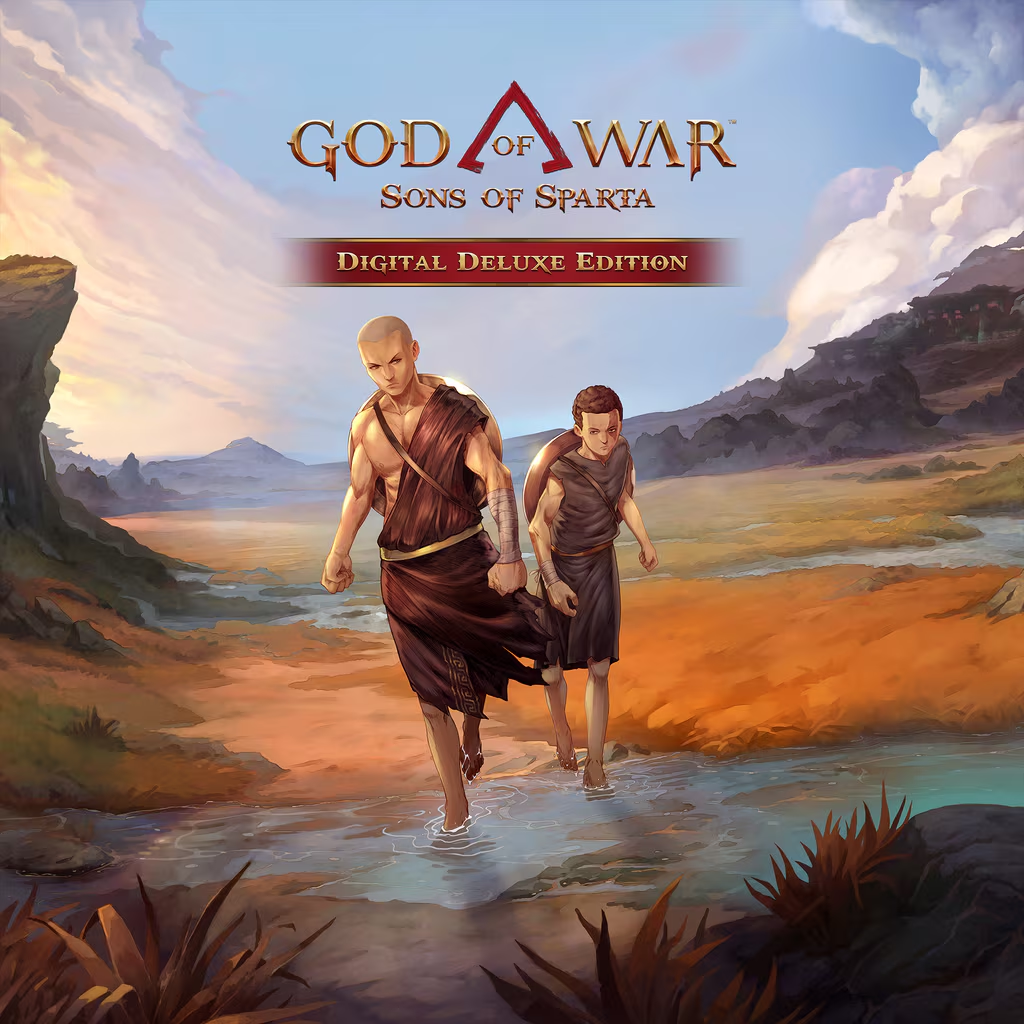
God of War Sons of Sparta takes the iconic series and gives us a 2D Metroidvania prequel. You will play as Kratos in his teenage years. He and his brother Deimos are Spartans training to become soldiers.
As one of their rank goes missing you’ll begin a twelve-to-twenty-hour long journey of discovery. This is a magical world filled with horrifying beasts, grown men voicing teenagers, some jank, and eventually, a solid adventure.

The Agoge
The game’s first four hours are bland, boring, and full of annoying voice work. If you can power through it, you will be rewarded with a rich story that fills in Kratos and Deimos’ backstory.
The overarching narrative is an adult Kratos telling a story to his daughter Persephone. She of course, alongside her mother, will be slaughtered by Kratos thanks to interference from Ares in the first game of the series.
Getting to see Kratos as a father, and as a teenager is interesting, though I admit I wish the game was an adult, god-powered Kratos to really make the Metroidvania trappings shine.
This setup works well for the story, eventually, as Kratos early on looks and feels more like a Bobby Hill than the eventual God of War. Deimos is brash, annoying as hell, though he too has an interesting and heartfelt change by the end of the campaign.

Sword and Spear
Sons of Sparta feels incredibly basic for a while for both the combat and the platforming. While the latter never changes that much, the combat goes from being something I hated to an almost fantastic system roughly halfway through the game.
Square is your attack button, and that never changes. What developer Mega Cat does instead is have you start using modifiers with L1 and R1 for dozens of different movies. Circle is your dodge, while R2 uses your currently equipped godly gift/boon.
X jumps, and roughly halfway through, you will get a double jump that makes the platforming more enjoyable. That is, outside the fact that they chose to have Kratos take chip damage and get pushed back if he touches an enemy.
It isn’t my favorite type of damage system in a 2D title. I prefer for readable attacks to be the way you take damage, outside of falling into pits or hitting spikes on walls, etc. Having to use the analog stick to move is rough as well. Your godly gifts and eventual heal are all tied to the d-pad.
As deep and fun as the combat can be in 1 on 1 situations the damage on touch can lead to some frustrating platforming and combat sections. If enemies surround you trying to use your dodge to get away can take seconds as you bounce between enemies, seeing your health quickly drop from full to zero.

Color Matching
The game uses a color system to let you know what type of attack is coming. It mostly works well, outside a few enemy types that give you little warning before the attack hits. There are yellow, blue, and purple attacks. One you cannot block, the other you cannot dodge, and one you can do neither and must avoid it entirely.
While bosses and larger enemies give you time to know which is which, there are some incredibly fast smaller enemies that attack the moment the color appears. Most only have two attacks so as long as you can memorize what they can do the game was never overly difficult.
As a Metroidvania Sons of Sparta encourages exploration. On normal difficulty, you will want to find every offering and upgrade possible for your godly gifts. You’ll slingshot, burn, and magic your way around the environments with consistent new abilities being dished out.
Fast travel is stuck with a between each temple system until near the end of the game. At one point, not long before credits roll, you will get the ability to fast travel between your camps. These are small areas that, in a Soulslike fashion, can be used to heal back to full but respawn enemies. I’d save your full map clearing for once you’ve gotten this ability, as the last fight of the game is far easier if you have as many upgrades as you can grind.

Upgrades
Kratos has multiple upgrade systems tied to the game’s classic blood orbs as well as various items you will find in the environment. Your gear consists of a spear, with various parts you can equip and upgrade. You have a shield, that also sees you craft new variants that can be upgraded for improved stats.
Each of your godly boons can be upgraded through two systems. The first are doing challenges at olive trees and the second is to find statues dedicated to them. Each gives you various upgrades and unlocks for the boons.
The game makes it clear how these systems work though it never pushes you to have to do them. I found it far easier once I had my gear upgraded with more health, stamina, and magic. The boon upgrades can be more damage or less meter usage.
Those meters are tied to how you attack. Regular attacks give you yellow orbs, which refill your Spartan Spirit meter. Magic attacks and breakable jugs give you blue orbs which power your magic meter back up.
Holding R1 while attacking changes the Spirit orbs to Health ones instead, being the main way you’ll heal outside of camps until you finally get your heal after the Winery section. The game does open up with a challenge mode co-op system post completion, sadly I only have one controller and couldn’t try it out.

Kinda-Blasphemous Looking
God of War Sons of Sparta is an alright looking game. I’m not a big fan of how the characters look in comparison to the backgrounds. Characters have a sprite-look, with incredibly smooth animations.
The backgrounds, on the other hand, are more painterly and static, with little animation most of the time. Some of the later sections have beautiful vistas, but it rarely feels cohesive.
It is by no means an ugly title, just a bit of a bland one for most of the game. The last few major bosses have some of the best designs in the title, which was welcome as I got real sick of fighting a different color variant of the same bird boss multiple times.
The graphics, they’re fine, what is mostly bad until it shifts into being damned good and emotional, is the story and voice acting.

Pitch Changing
God of War Sons of Sparta features a lot of young teens voiced by grown adults using pitch changers. It never sounded right, even when the story took a more mature turn with its emotional ending.
The voice acting isn’t ‘bad’, but the dialogue is early on. Kratos is boring, Deimos is annoying, and the surrounding adults are stock-standard characters. Everyone, as per usual in the series, uses an American accent.
As someone who loves history and has a Greek friend hearing the way the God’s names were pronounced was a little jarring. Thankfully, the music was always good and occasionally excellent.
It loops a lot early on, but it’s a damned good loop in the forest area. Sound effects hit that occasional nostalgia part of my brain as well. As I said earlier, the story picked up roughly three-quarters of the way through.
It wasn’t enough to make me love it, but it was a solid shift from aimless stumbling around while looking for a lost kid into something deeper and more meaningful by the end.
Playing on a base launch PS5 Digital the game ran well, though using Rest Mode did nearly destroy my run. A few times I defeated a boss only to find that I could do nothing and that my last save was well before the fight, so I would avoid using Rest Mode in this one.

Wrapping Things Up
God of War Sons of Sparta has a weak start, solid middle, and strong ending. If you can get through a tedious first few hours you will eventually be rewarded with solid combat and an emotional story.
God of War Sons of Sparta
Played on
PlayStation 5
PROS
- Soundtrack
- Combat
- Upgrade System
CONS
- Voice Acting
- First few hours