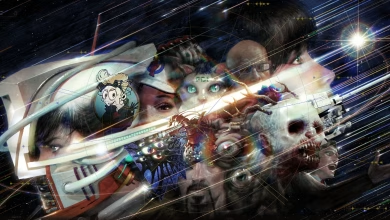
Shinobi: Art of Vengeance has sublime combat and some of the best visuals I’ve ever seen in a video game. As Joe Musashi, you’ll chase a boring bad guy throughout a convoluted story. Many aspects of this game are amazing, but it is all massively let down by imprecise platforming that only causes frustration. Despite these issues, I still loved the game overall; the combat and looks are that good.

Mmmm
No spoilers for the story, know it is a tale of vengeance, told through stunning artwork for roughly 15 hours of my time, and upwards of 30 or more of yours if you want to 100% everything. Joe Musashi’s Oboro clan faces destruction at the hands of Lord Ruse. Ruse is a bit of a generic douche bro-type looking bad guy. The story is serviceable, the voice acting is occasionally not bad, and it never got in the way of enjoying the experience.
There’s a lot of variety on offer in Shinobi when it comes to locales. You’ll go through Neon-soaked cityscapes, deserts, weird labs, and more as you chase down Ruse and his gang of goons. Where Shinobi shines is in its artwork. Art of Vengeance has some of the greatest character animations I’ve ever seen.
None shines more than the titular Shinobi, as his slicing, dicing, and magical moves look incredible every time. Ninpo attacks and Ninjitsu ultimates fill the screen with colors and pencil drawings that are as good-looking as any 2D game has ever been. While the backgrounds aren’t “bad,” they do not match the stellar quality of the hand-drawn characters. What can match it is the combat.


Die
Lizardcube takes their excellent work on Streets of Rage 4 and dials it up to 10 with Shinobi. Joe is fast, fluid, and extremely deadly. X is your quick attack, while Y is used in a variety of heavy moves. While the game features linear level design, there are Metroidvania elements, with progression blockers requiring you to replay levels after unlocking abilities tied to later missions.
To help with that is a checkpoint/fast-travel system that makes loading through each level to find secrets a breeze. To get around, you’ll have a double jump from the start as well as a ground roll and air dash. Those moves, mixed with later unlocks, will see you flying around the battlefield as you rain death upon a decent variety of enemies.
Fodder foes have simple red health bars and can be knocked around by your attacks. Tougher bad guys will see that health bar covered by yellow armor. Heavy attacks and your shuriken can help bring down the armor, with a satisfying slow-motion effect letting you know once they are vulnerable.
Tougher enemies have a white bar that fills up underneath their health. Heavy moves and shuriken hits fill it faster, and once it’s up all the way, you can hold LB and press RB to kill them instantly. Building this up on 5 characters and taking them all out in a flurry of dashes is one of the best feelings I’ve ever had in a video game. Make sure to use it on bosses for some insane visuals as well.
Style permeates every part of Shinobi: AOV. The game oozes with artists and combat designers who get what makes this shit so damned cool. They are operating at the top of their games, which sadly isn’t the case when it comes to the game’s platforming.


Art of Frustration
For the majority of the game’s golden path main content, the platforming sections are serviceable. Where it fell apart for me were the numerous optional areas, denoted by a purple background on the map. In these areas, the game ramps up the difficulty, offering you various rewards like Oboro clan relics (used to open up more moves/shop items) and basic stat boosts.
By the end of the campaign, I had experienced at least five two+ minute long platforming challenges that required perfect movement, with a single mistake sending you back to the start. Shinobi is full of instant-loss-send-back-to-the-start mechanics. Unlike recent titles like Prince of Persia: The Lost Crown, it simply isn’t tight enough to warrant it.
Far too often, I found myself clambering up edges, moving far more than I wanted to, and dying repeatedly to issues that didn’t feel like I had made a mistake. There are ninja claws that can be used on walls with white gem-looking rocks in them. The number of times I jumped into these walls and my character refused to grab on must be in the hundreds.
It’s fine to have difficult content. When I completed these areas, I never felt satisfied, saying “that was amazing” like I did with the combat. Instead, I couldn’t believe it existed, as no one could ever find this enjoyable. To be 65 seconds into an incredibly difficult platforming section, only to have Joe decide to clamber up into a death spike and reset me back to the start for the 20th time in a row, had me hitting my head on my desk.
Every other part of this game is damned near perfect, and I hate having to focus on this so much. The last area of the game is insanely cool, with a boss fight that was unbelievably difficult but tied to my skill set. I knew how to do this platforming, but finicky controls on when Joe would decide to fall to his death or climb into a laser made it nearly impossible. Thankfully, there is a lot of other stuff to do in this one that is damned fun.

A Large Canvas
Shinobi is a long game. I could have golden pathed the main content in roughly 6 or 7 hours, though it would have been far more difficult. I got 100% clear on roughly half the stages, with at least 80% or higher on the rest. Going back and clearing up secrets, finding Oboro Relics, and other special areas was a blast most of the time.
While the frustrating platforming took place in these secret areas, they were necessary to build up Shinobi’s power, move set, and health. Other things happen once you roll credits, which I will not spoil. I think it’s safe to say that getting everything unlocked could take an easy 30 or 50 hours.
Those Oboro Clan Relics are used at the in-game shop to unlock new moves, amulets, Ninpo, and more. There is a collection of base moves that add new combos or abilities. Alongside these are amulets, of which you can wear an active and a passive version at a time. These are the most you can customize your playstyle, alongside the Ninpo, which they can empower.
Ninpo are magical moves like breathing fire, summoning a giant snake, or setting up an extremely powerful parry attack. Finally, the Ninjitsu ultimate abilities are built with your Rage meter, and feature four unbelievably good-looking animations as you use them. Unlocking everything you can is worth it, as the game gets damned hard. If difficulty isn’t your bag, you can give enemies less HP, make them hit you for less damage, and choose other assist options in the accessibility menu.

Wrapping Things Up
Shinobi: Art of Vengeance is a 10 when it comes to combat and visuals. Incredible replayability, a decent story, and a good soundtrack are let down by frustratingly imprecise platforming. Still, the other parts are so strong that I can easily recommend this game to damned near anyone.
Shinobi: Art of Vengeance
Played on
Xbox Series X
PROS
- Incredible Visuals
- Excellent Combat
- Solid Replayability
- Decent Story/VO
- It really is gorgeous
CONS
- Imprecise Platforming
- Lack of Checkpoints in Optional Content