
The Dreamcast is back!


Thanks to the kerfuffle caused by Xbox fans after the Mavel vs Capcom Fighting Collection initially skipped Xbox, the Capcom Fighting Collection 2 is launching day one with other platforms! But unlike the former, this Collection is a far more niche suite of classic fighters mostly based on Sega’s Naomi hardware aka the Dreamcast, so it’s somewhat disappointing to see the missed opportunity to call this the Capcom Dreamcast Fighting Collection.
But that’s just the inner Sega fanboy in me yearning to see the Dreamcast being acknowledged in 2025. Pay no mind to me.
Except when reading the rest of this review!
Welcome to Power Stone World!


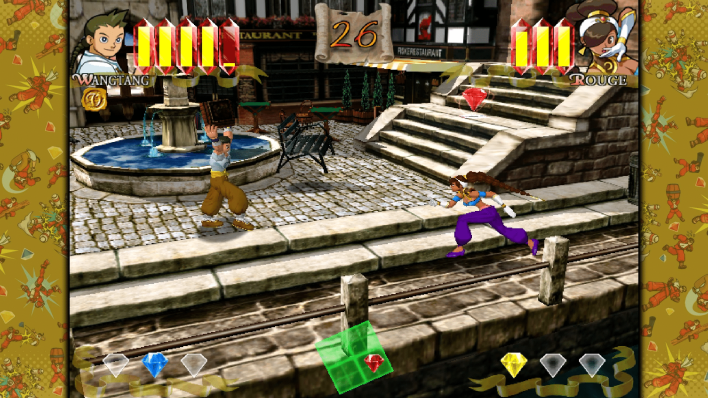

Structurally, The Capcom Fighting Collection 2 is identical to the Marvel vs Capcom Fighting Collection. I really mean indentical. Outside the actual collection of games included, everything else is the same. The Menus, UI, options, extras and modes, all of it.
So if you haven’t already, check out my review of the Marvel vs Capcom Fighting Collection Arcade Classics where I break down what’s included in these more recent Capcom Collections.
The jist of it is? You get it all, the good and the bad. You get all the neat features like customisable controls, the accessibility options, the awesome Galleries of artwork, the Soundtracks, Training modes and even the recent feature update from day one!. I strongly recommend upping the internal resolution by two for the games that support it. It makes a tangible difference on the 3D games and games with 3D backgrounds. But yes…you also still get the absolutey criminal single save state that works across the entire collection. How they managed to actually go to the effort to release an update for these Collections (which they never ever do mind you) but not address arguably the single biggest issue is beyond me. But anyway…
This time around the games involved are:
- Capcom vs SNK : Millenium Fight 2000 Pro
- Capcom vs SNK 2: Mark of the Millenium 2001
- Capcom Fighting Evolution (Fighting Jam in some countries)
- Street Fighter Alpha 3 Upper
- Power Stone
- Power Stone 2
- Project Justice
- Plasma Sword: Nightmare of Bilstein
Let’s be real, this is – for all intents and purposes, a Dreamcast Fighting Game collection and I absolutely love it for that. But as I mentioned earlier, the titles are so niche I’m going to do something a little different and actually briefly cover the games involved for those who may not be familiar.
Power Stone and Power Stone 2


This is it…this is why we’re here! Power Stone 1 and 2 finally come to modern consoles. Yeah they’re not remasters and yeah we don’t have Power Stone 3 yet but maaaaan we’ll take what we can get.
Power Stone is synonymous with the Dreamcast. It’s the original arena fighter and an absolute classic that in my humble opinion, holds up to this day. Where fighters of the time were on 2D planes and some had some side stepping to add “3D” to them, Power Stone threw out the rule book and pit the combatants in a full three dimensional arena with interactive enironments and tonnes of items within them that can be used as weaponry.
As the name implies, the secondary objective of each fight (outside the primary being to, you know to reduce your opponents health bar to nothing) is to collect the three Power Stones that turn you into a super being capable of mass destruction for a limited time. If an opponent gains a Power Stone, be sure to hit them to release it back into the arena and try collect it yourself. It’s incredibly fun and way ahead of it’s time.
Power Stone 2 takes the insanity and ratchets it up to 11. How? By making the fights a four way rumble and having the environments change or move along as the fight progresses. It’s a party game on meth. There can be moments of chaos so full on that you genuinely will have no idea where you are or what’s going on. But in a fun way?
But seriously it’s just so good to have Power Stone back and I say this with all bias, this collection is worth it just for the Power Stone games. Particularly with online play.
Capcom vs SNK and Capcom vs SNK 2


You have to understand, before 2000 (technically 1999) the idea of a cross over fighter between competing fighting game developers was unheard of. When Capcom vs SNK Millenium Fight was announced it was a big deal.
The execution of both games was ultimately excellent. Capcom vs SNK took the SNK four button approach and Capcom vs SNK 2 took the Capcom six button approach. Both then melded bits and pieces from both Street Fighter and Fatal Fury histories to create something pretty special.
The real uniqueness of the titles was in the “ratio” and “groove” systems. In the first game, how many characters you could pick for your team depended on the characters you chose and their strength rating. The stronger the character(s) the smaller your team, so expert players would study and learn the best balance that works for them. I just always chose Terry and Ryu lol. Capcom vs SNK 2 tweaked the ratio system somehwat by having all teams comprise of three fighters, but you then adjust the ratio of the fighters within the team.
The Groove system at it’s core was you picking a fighting style. In the first game you picked between a Capcom groove or an SNK groove. The Capcom groove aligning more Street Fighter Alpha’s style and the SNK groove to King of Fighters. Capcom vs SNK 2 goes deeper with a total of six grooves, all designated a letter. C, A, P, S, N, K are your choices and all give you a different play style from a game in either Capcom’s or SNK’s history. As an example, the “C” Groove is the standard Street Fighter three level super combo system, where as the S Groove is the extra gauge and special move system which started with King of Fighters 94.
There’s a tonne of depth and customisation to it and the only thing that was arguably missing here is the ability to tag a team mate in a la Marvel vs Capcom. But many won’t mind the linearity of taking turns.
Capcom Fighting Evolution (Capcom Fighting Jam outside the US)


Capcom Fighting Evolution (or Jam as it was known outside the US) truly is the “ugly duckling” of the family here. How to best explain Capcom Fighting Evolution…
Capcom Fighting Evolution is kind of what you’d get if you asked me to learn how to mod games and I did my best to squish together three different Street Fighter games, a couple of Darkstalkers games and Red Earth. No seriously. They took random variants of existing characters from different Street Fighter games, Darkstalkers games and almost a handful from the ultra niche Red Earth and just chucked ’em in there. Straight up. No tweaks, no adjustments, no enhancements, nothing.
There’s also a completely unknown original character named Ingrid who is from a cancelled Capcom Fighting All-Stars game. But that’s it really. There’s not much more to it. As long as you know or remember how each character played in the game they came from, you can use them here. Then a tag system was thrown in for good measure.
As you can imagine, this game wasn’t very popular and didn’t perform very well. I bought it on PS2 back in the day though so yay for me.
Project Justice


Project Justice (known as Project Justice: Rival Schools 2 in some countries) is a very quirky and welcome addition to a collection of already pretty niche fighters. In terms of setup, as the alternate name implies, you select a team of three students and fight students from rivals schools and universities in a fictional world.
In terms of gameplay, for anyone who may remember, Project Justice plays very much like the Street Fighter ex games from Arika. To the point where I have to wonder if much of the Arika team worked on it. But I don’t think the timeline aligns on that possibility but they’re so similar in feel that I refuse to accept any other explanation.
For those not familiar with Street Fighter ex, it was a 3D characters on a 2D plane Street Fighter game long before Street Fighter IV existed made by Arika (former Capcom devs) and played like a much heavier and clunkier version of the 2D Street Fighter games. That’s how Project Justice feels. Just like that. It’s also taken many elements from the Capcom crossover games like X-Men vs Street Fighter like tagging in team mates as well as Party-Up techniques that change with the level of meter.
One pretty unique aspect to the game is in its story mode. I say unique keeping in mind this was 2001 (2000 in Japan). To have a true story mode in a fighter at all was pretty unique, let alone one that had branching storylines depending on results and a structure that changed depending on the school you chose the students from.
While this title isn’t the star of the show, it’s arguably the most important addition due to it’s exclusivity to the Dreamcast. There’s simply no other way to get this game outside having a Dreamcast. Oddly, the first game has never been re-released anyway and remains stranded on the original PlayStation (and arcade)
Plasma Sword: Nightmare of Bilstein


Much like Project Justice, Plasma Sword is a Dreamcast only sequel to an old Arcade and PlayStation title. In this case, Star Gladiator. Now, when playing Plasma Sword I couldn’t shake the feeling that this was the least Capcom feeling fighter I had ever experienced. It felt far more like a SoulCalibur or Tekken game to me. Upon discovering that the arcade game was made for the PlayStation based ZN-1 hardware (as opposed to Sega’s Dreamcast based NAOMI hardware like most other games in this collection) it starts to make more sense.
Now, feeling more like a Namco game than a Capcom game isn’t a bad thing. It’s just jarring to experience in a Collection of Capcom fighting games that feel so inherently Capcom. This (and it’s predecessor Star Galdiator) is also the only weapon based fighter in Capcom’s stable, which also gives it quite a point of difference.
To further separate itself from it’s relatives, Plasma Sword also uses a completely different control scheme to traditional Capcom Fighting games. As opposed to the more traditional Light, Medium and Heavy variants of punches and kicks (or in more recent times, just Light and Heavy) you have two separate “Attack” buttons, a dedicated “Kick” button and a “Sidestep” button allowing the player to make use of the 3D space much like SoulCalibur, Tekken and Virtua Fighter.
Outside that, much of the rest of the combat involves the stuff you’ve grown accustomed to in Capcom fighters post this era. Combos, Special meters and Counter attacks are all at your disposal.
Like Project Justice, this is a very welcomed addition to the lineup both due to how different it is and how impossible it is to access this game any other way outside owning a Dreamcast.
Street Fighter Alpha 3 Upper


Now we come to the strangest game in this collection. Why is it strange? Because it’s very clearly the odd game out in that it’s fairly mainstream, has been ported to way more retro platforms (making it easier to get), is already in far more recent Capcom Fighting game collections and is missing the awesome World Tour and Dramatic Battle Modes seen in other versions of the game.
The only reason I can think of for its inclusion is the fact that it’s fighting system is the basis for so many of the other games included in the collection? Other than that I’m not sure because this is already accessible via the Street Fighter 30th Anniversary Collection and the Capcom Arcade 2nd Stadium. Having said that, the Game Boy Advance was the only way to play Street Fighter Alpha 3 Upper previously. So maybe they just threw it in here to have a modern port of that.
But I suspect Alpha 3 doesn’t need much of an introduction. It’s the closest thing to “Street Fighter Smash” as we’ve had as it has a massive roster spanning a bunch of Street Fighter games (including Final Fight which is canoncially Street Fighter).
It introduced the concept of “Isms”, which gave the player a choice on the type of fighting style you wanted to use. These “isms” came from Street Fighter Alpha (A-ism), Street Fighter Alpha 2 (V-ism) and Super Street Fighter II Turbo (X-ism) with each working just like the game they were inspired by.
Like all Street Fighter games, make your around around the world across 10 Stages taking out opponents using the tried and true moves we’ve all long developed muscle memory performing over the last 30 years.
While Alpha 3 is an odd inclusion, it’s not an unwelcome one. It’s just definitely not the reason you’re buying this collection.
It may be thinking, but you don’t need to


While this Collection doesn’t include the mainstream hits the Marvel vs Capcom Fighting Game Collection, it includes a far better selection than the first Capcom Fighting Game Collection and as I mentioned earlier, is well worth it for the Power Stone games and the ability to play them online.
Speaking of, unlike my time reviewing the Marvel vs Capcom Collection, I actually managed to play a few games online here surprisngly and I was actually very pleasantly surprised at the experience. The rollback netcode worked admirably and I had a blast experiencing Power Stone online for the first time.
Given the rarity of these games, players should really appreciate the contents of the Gallery and Music within the Museum.
As this is the only way to get these games at home outside a Dreamcast, PSP or Emulation I strongly encourage fighting game fans to jump in and absolutely lose themselves in the Power Stone world! Play the other games too…
Capcom Fighting Collection 2 | Review
Played on
Xbox Series X

PROS
- POWER STONE
- POWER STONE 2
- Incredible selection of niche rare fighters mostly only avaialble on Dreamcast
CONS
- One save slot for the entire collection
- No cross play