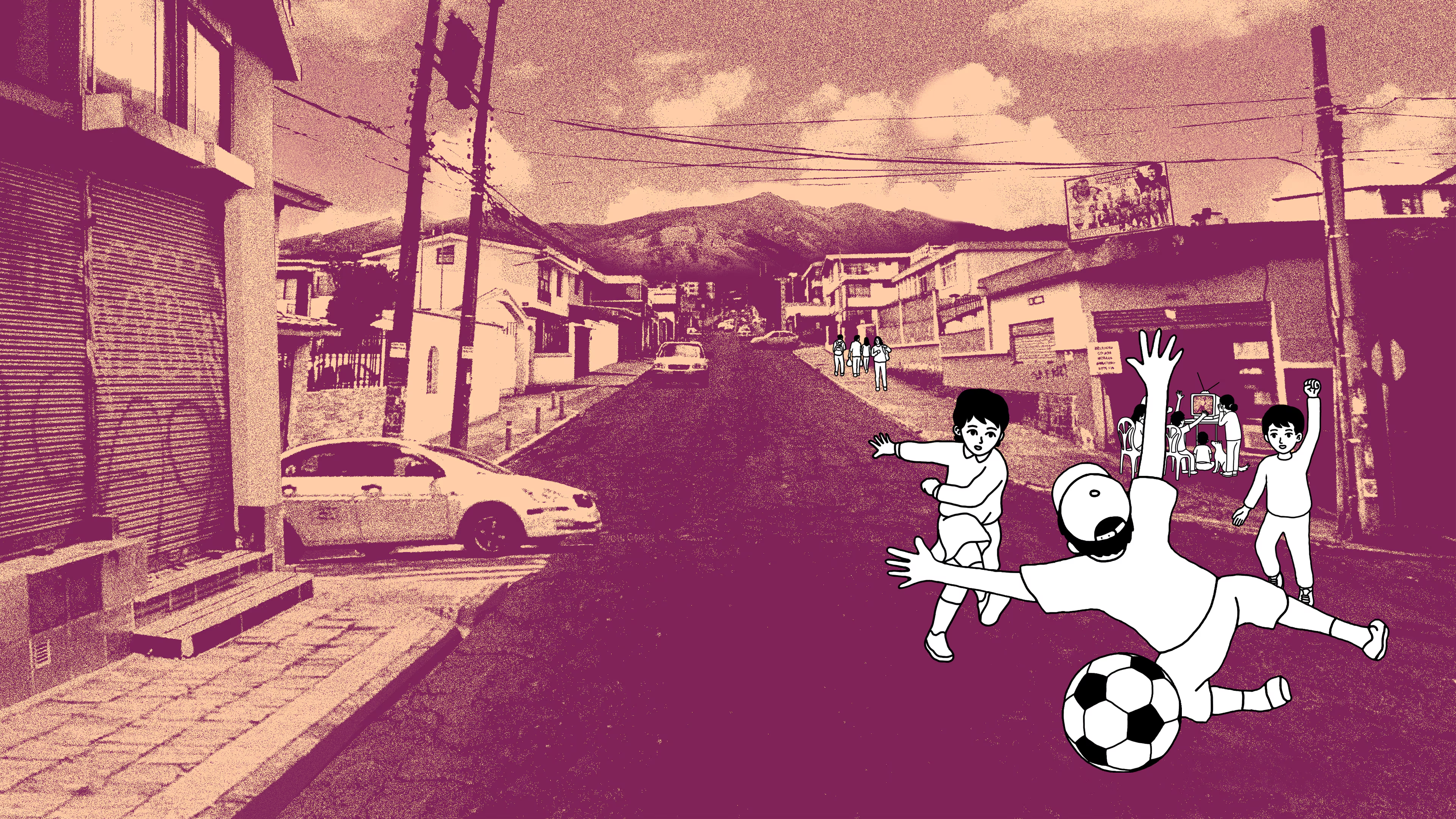
Mechanically speaking, Despelote is a football (or soccer, if you’re from the US) game. It’s not trying to compete with EA Sports’ or Konami’s offerings, nor emulate arcade classics like many other indies. It merely uses its gameplay hook of kicking a ball towards a single goal (pun intended): delivering a deeply emotional and inspirational storyline set in Ecuador. Intrigued? So were we. Here’s our review of Despelote on Xbox Series X!

Ecuador! Dun-dun-du-du-du-du-du-dun-dun
The context in which this peculiar indie is played is also a time and place that I don’t think any indie videogame ever tackled. It’s the early 2000’s, and the small South American country Ecuador is on the verge of something historical: qualifying for the 2002 FIFA World Cup, the biggest football/soccer tournament, pitting the best nations against one another. Ecuador has never achieved this goal, and the entire population caught a case of the football fever – everyone loves the team, the sport, and their players reaching the World Cup would be one of the best things their beloved country has ever achieved.
This potential upcoming sport miracle comes at a time when everyone needs some hope, some dream to latch onto. A new series of VATs and tariffs is having devastating effects on the economy, with many families struggling to figure out how to make ends meet. There’s one group of people who don’t have such worries: children. Enter Julian, an 8 years old boy who spends his free time either playing football on the streets with his friends, during recess at school, or even football videogames at home. And while the world around him is uncertain as ever, Julian only wants to kick a ball around – hopefully becoming good enough to one day write a heroic story for the Ecuador national team himself.

Kicking around town
In a game that takes about two hours to complete, it would be a disservice to dissect too many gameplay quirks or scenarios the players get to encounter. But at its core, Despelote is played from a first person view, and in the way a young kid tends to life live. That is: thoughtless, full of energy, hyperfocused on their dreams and passions. The world around them may be scary, puzzling, and give them directions – such as running back to class on time, getting back home before dark, doing homework instead of playing videogames. Yet the desire to have fun, to run after the ball is what Julian seeks, and it is effectively the gameplay hook of the title.
The players gets to explore various locations – the school, a park, the town’s streets. Playing with friends or alone, Julian spends most of the time kicking the ball around, sometimes with a goal, sometimes for pure fun. There’s a fun, if initially somewhat clunky mechanic that allows the player to flick the ball by “charging” the leg, thus managing the power and direction of the ball. But this is merely a stepping stone, a tool towards immersing yourself a unique time and place, in a world dominated by football fever and far more damning worries alike.

He will never be ballin’
The scenes in the game are presented in a very stylized fashion, resembling dreams and memories rather than something actually happening in real time. Indeed, scenes can cut to one another without any prior warning, just as our brain would jump from one scene to another. The world is presented in a unique monochrome, TV static infused realistic look, where the only things of interest (such as people, the ball, vehicles, and in general, most of the things you can interact with) are in a more minimalistic, cartoony and flat style. This means that, as it were a classic first person game from the early 90’s, you’ll see flat 2D sprites rotate in a 3D environment, which gels well with the nostalgia-filled ride of this virtual Ecuador of the early 2000’s. It’s a simple-sounding, yet detailed and rich visual style, one further enriched by an excellent soundtrack and believeable voice acting in Spanish – with obviously English subtitles, or more precisely, comic-style text bubbles to boot.
It is a personal journey of the very developers, too, who were mere childs in this extremely specific contexts. They manage to recontextualize events that, when they were younger, did not fully understand. They manage to share very specific stories and events that happened to them and, in a more immediately noticeable fashion, how the football fever practically froze the nation. You’ll see people stop their daily commutes because a TV screen with the match on happens to be outside of a shop window. Families will be discussing how to manage to watch the most important football match of their lives during a family member’s very own wedding. There’s even an in-game football videogame that can be played, one mimicking the top-down sports games of the 90’s. Despelote really is a love letter to football, to a country, to a childhood.

Hopes and dreams
Indeed, among some deeply personal and sad anecdotes, this game manages to be a strangely beautiful and hopeful experience. The economy is as fragile as ever, the future is a giant question mark, and yet, there’s a dream. If Ecuador qualifies to the World Cup, perhaps, the suffering, the anxiety, the hardship was worth it after all. For Julian, whose life is far from easy, having fun with the ball to kick around and dreaming of one day becoming like his football heroes is exciting enough to keep going through the hardships. And the joys of chatting and playing with friends, the fascination of interacting with adults who seemingly have it all figured out – it makes for fascinating memories worth revisiting.
Despelote is exactly that. In a mechanical sense, it is little more than a hypothetical first person “Kick The Ball Simulator”. And yet, it immerses us into an Ecuador of recent past, one that, for a brief moment in time, was able to forget some of the economical woes; uniting behind a heroic football team that, perhaps, will beat the odds and qualify for the World Cup. If you know your football history, you may already know how that story ends, but even that knowledge can’t spoil you the joys of Despelote. It’s short, there’s not much replayability or player agency, and there’s a couple mechanical shortcomings. Yet, it hardly matters. Despelote is one of the year’s most fascinating indie games, one I can recommend without much hesitation.
Despelote
Played on
PC

PROS
- A perfect simulation of childhood
- A deeply emotional ride
- A jump into a unique cultural place and time
- A lovely artstyle
CONS
- Slighty wonky controls
- Very short game with little replayability