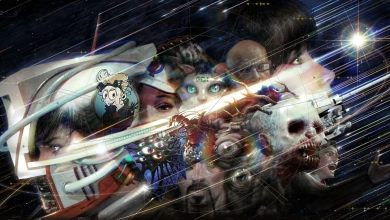
Welcome to Split Fiction, the next game from the masters of co-operative game design at Hazelight Studios. Their last game, the wonderful “It Takes Two“, sold 23 million copies and won Game of the Year in 2021. Can Game Director Josef Fares and the team at Hazelight do it all again?
The answer my friends, is a resounding yes. Yes, they can, and then some.

Met Mio, Zoe and the Evil Empire
In Split Fiction, you and a friend will play as Mio Hudson and Zoe Foster, two aspiring authors who randomly meet at an event being held at Rader Publishing, a giant mega-corporation in the book-publishing world. Here, under the mistaken belief that they’re finally getting their big break and collecting that long awaited publishing deal for their work, they instead soon find themselves on one crazy adventure.


Rader Publishing is led by absolute megalomaniac J.D Rader, (played brilliantly and with just the right amount of self-righteous-awfulness by Ben Turner) who in a speech to the awestruck duo declares that he’s on the verge of releasing a product that will “reshape the foundations of the entire industry.” How will he do that? With J.D Rader’s ‘life’s work’ – the ominously named “Machine“.
Surprise! Mio and Zoe aren’t their to submit their work for an easy publishing deal. Instead, they’re asked to strap themselves into this futuristic gizmo, which is designed to scan their brains and suck out all their stories by putting them into virtual worlds based on their ideas. The ‘Machine‘ will simulate the authors stories in a virtual world, recording and storing it all to be packaged and published. What could go wrong?

Mio is not at all pleased with this turn of events, and panics, stepping off of her assigned pad during the machine’s start up. Rader grapples with her, and whoops, she’s pushed into Zoe’s pad instead of her own. It’s here where the magic begins.
Zoe is a somewhat twee extrovert, who will initially come off as incredibly annoying and infuriatingly positive. On the other end of the spectrum, Mio is far more cynical and almost bitter – to the point of being completely unlikeable at first, with quite a large chip on her shoulder.

In terms of plot, I’m not going to spoil a thing, except to say that Mio and Zoe are complete polar opposites in terms of personality, and that who they are, and why they’re there is what is fundamentally pushing the narrative forward. Both are isolated in different ways, and their blossoming friendship is the true heart of the game.
They each have their own backstories that you and your friend will unravel and learn more about as you play, and while I started off feeling fairly cold on both characters, the lead actresses, Kaja Chan (Mio) and Elsie Bennet (Zoe) put on a masterclass in performance, where both characters felt like real people, completely turning me around on them both by the time I rolled credits.
And despite the sheer insanity on offer in terms of gameplay and the utter craziness of the plot, the personal stories of both these characters hit, and hit hard. I laughed, I choked up, I ooh’d and ahh’d in awe. Their stories are very ‘real’ in a way that most video game stories just aren’t – and importantly, are told through gameplay incredibly well.
Unleash your Full Creative Potential

Where to even begin in describing to you just what’s on offer with Split Fiction? Just like Hazelight’s previous work, A Way Out and It Takes Two, you and your co-op buddy will share the screen, each being able to see what the other is up to at all times, in both online co-op with the ‘Friend’s Pass’ (It’s cross-play this time, in case you missed the memo) and in local play.
With Mio and Zoe both trapped in their own stories, you’re constantly swapping between the more magical and fantastical worlds and tropes of Zoe’s imagination, and the more grounded, dystopian sci-fi universes and ideas that Mio has cooked up.


While the majority of the game utilises that mid-screen split, Hazelight are constantly mixing it up, with the screen moving seamlessly to bring the players together, changing the genre of game being played entirely on the fly and equipping Mio and Zoe with ever changing powers and abilities.
Whether you’re running and gunning, manipulating gravity or shapeshifting into a groot-like tree or a giant monkey, it’s remarkable, and even more so that it remains so wonderfully intuitive throughout, with controls always feeling tight and responsive.
I mentioned different gameplay genres, right? While a lot of the game is a typical 3rd person action platformer, in my fifteen or so hours with Split Fiction, I played an entire smorgasbord of different gaming-genre delights, all with a co-op slant.
From a futuristic take on Wave Race and SSX, 2D and 3D platformers, isometric dungeons, flying on the backs of dragons, riding Tron-like motorbikes through a sci-fi city, escaping a dying star or blasting cyberpunk cop-cars in an on rails-shooter, Split Fiction is never short of ideas on how to keep things fresh and exciting.


There are a ton of riffs and nods to classic video games like Assassin’s Creed, Megaman, WaveRace and even Halo hidden throughout, and the sheer attention to detail is just jaw-dropping. There’s also a lot of brilliant humour, and that usually comes in the form of Split Fiction’s ‘side stories’.
More Than Just a Side Story

When navigating our way through either Mio or Zoe’s imagined worlds, each of the larger levels is either sci-fi or fantasy slanted, so to keep things from getting stale, Hazelight sprinkled an ‘optional’ (they’re not optional, you should play every single one of them) twelve side stories during the larger, longer levels.
If the main level you’re playing is predominantly in Mio’s sci-fi leaning imagination, the side stories will be more fantasy based, and vice versa. It’s usually here where Hazelight are at their most imaginative, be it facing off against a evil robot dentist as cutesy milk-tooth, rescuing cats in a magical Hogwarts-like world or playing as pigs in a mission to become hotdogs, it’s all absolutely brilliant.


One my favourites was a pencil-drawn styled side-scroller, replete with derpy-looking horse where we had to go and rescue a prince. Taking place during a story from Zoe’s childhood imagination, she kept changing her mind on the actual plot, with a pencil coming in and erasing or making hasty additions on the fly.

Another had Mio and Zoe grapple with surviving and preventing a dying star from going supernova, the energy destroying everything in powerful waves as we cooperatively worked together to contain it. The sheer spectacle on display was jaw dropping, the gameplay on offer a singular, stand-alone indie game in and of itself – and yet for Hazelight, just another enjoyable but entirely temporary diversion from the main plot to be played before we’re back on track.
In addition to the sheer variety in moment to moment gameplay, there are also numerous boss battle showdowns to contend with, be it against evil robotic parking attendants, adorably evil cats (cuddles or death?) or dance-offs against a Disco-obsessed Ape King, again, the game always asking the player to take on a new skill, ability or challenge.
Skillz to pay the Billz

If I have any criticism of Split Fiction, is that while it is sumptuously designed, beautiful to look at and an absolute joy to play, for an experienced gamer, there isn’t a huge amount of actual challenge here. The checkpoints during levels and indeed boss battles are just a little too generous, making it a fast-paced but ultimately frictionless experience from beginning to end.
During the review period, I’ve actually been playing the game with two different people. The first, someone I’ve been playing games with online for twenty years, the other, my partner, who has played few games ever in her life, though she really wants to. The biggest barrier for her? The controller, and simply having your brain wired to navigate a character through a 3D space through the manipulation of twin sticks. For her, the game has been a real challenge, but we’re getting through it. Slowly.

For my review playthrough, my friend and I had a great time, but I’d love to see a difficulty setting that demands the more experienced gamer have to complete entire longer sections without failing to bring a little more challenge to proceedings. Overall, it’s a minor complaint, and I’m not going to hold Hazelight making the game accessible to more players against them.
While the majority of this review ending up being on PC due to a hiccup with my EA Account (now resolved) the game runs great on Xbox Series X. While it doesn’t look quite as nice as it does running on my PC with everything set to max, its performance is rock solid. I’d imagine that it has to be, because as I mentioned previously, the game’s unique ‘Friend’s Pass’ means you can play on Xbox, while your partner can be on PC or PlayStation 5 – so everything needs to be the same for smooth play.


A Phenomenal Celebration of Video Games

I want to say more about Split Fiction – a lot more, but to peel back the curtain any further would be a disservice to you. While you think you may know what to expect if you’ve played some of the previous works from Hazelight, the end of Split Fiction takes things even further than I thought possible.
I can only describe it as the most bonkers, out there piece of game design I have ever encountered in my many long years playing video games. It has to be seen, played – experienced – to be understood.
Split Fiction is, at its heart, a celebration about how wonderful, imaginative and downright clever videogames can be when they choose to embrace what they are – an art form that thrives on interactivity, creativity, and boundless possibility. Hazelight have proven that once again, when it comes to building distinct experiences that blend storytelling, mechanics, and player agency – they have no equal.
Spectacular.
Code provided for this review by the Publisher.
Split Fiction
Played on
PC & Xbox Series X

PROS
- An delightful medley of video game variety and sheer imagination
- Fluid controls and smooth performance
- Cross-Platform Friend's Pass works great
- A surprisingly deep, relatable story, with excellent performances all around
- Looks and sounds fantastic
CONS
- A bit too forgiving for those seeking a challenge, but also challenging for the inexperienced.