The sequel to a fan favourite game, Kingdom Come: Deliverance 2 has been hotly anticipated for years and years now. The game has you continue Henry’s story as he goes to new areas, meets new people, and makes new friends and enemies alike. Will we finally see his quest resolved? And did Warhorse Studios pull it off once again? That’ll be up to you to decide of course, but keep reading to think what we thought in the XboxEra Review.
What Do You Mean It’s Been Seven Years?

A quick disclaimer before I dive in, while I was always interested in playing through the entire first game, I sadly never ended up doing so. Meaning, this review is written from the perspective of someone almost entirely new to the franchise. If you’re looking for a complete breakdown and comparison between the two games, then you’re in the wrong place. But if you’re looking to see what someone whose first game in the series was this one, then keep reading on!
Kingdom Come: Deliverance 2 is a direct sequel to the first game. And I don’t say that lightly. The game quite literally takes place almost instantly after its predecessor and while the game does spend a little time going over past events, for the most part, it assumes you’re familiar with the main character, his motivations, and his story thus far. While I hadn’t played much of the first game, I did make sure to go watch every cutscene and major story moment I could from it (it was something like eight hours long) and yeah while that took a bit of time, I think it’s worth doing for anyone who’s interested in the narrative but wants to dive right into the sequel. Warhorse Studios, the talented folks behind both games, have several videos on their YouTube channel that help here. One is a collection of all the major cutscenes and story moments from the first game (which is around five hours long) and they also recently released a much shorter “recap” video.
Just One Cutscene Away

I’m going to keep my review as spoiler lite as I can, and that will include the first game as well for the most part. What you need to know really is that the game starts off with you accompanying Hans Capon as a bodyguard (and a friend) to deliver a message to Trotsky. Why? Because you’re caught up in some deeply political matters concerning a missing King, his brother, invaders from other areas and more. Kingdom Come: Deliverance 2’s story can get more than a little confusing with the many, many players involved, their motivations, etc. But you’re given more than enough tools and information to really dive into it all if you want to. And if you don’t (as I didn’t really), then that’s okay too because the core of this game isn’t about the big bombastic stories anyway.
I did want to mention how much I enjoyed the in-game way they chose to offer a recap of sorts of the major events from the first game. You’ll know exactly what I’m talking about when you see it, but it’s those kinds of moments that truly capture the cinematic vibe of the story being told. Anyways, soon after you start the game you’re given your first major goal, infiltrate a wedding that’s happening in the area. And that’s when the game lets go and gives you control to do what you want.
Up Close and Personal
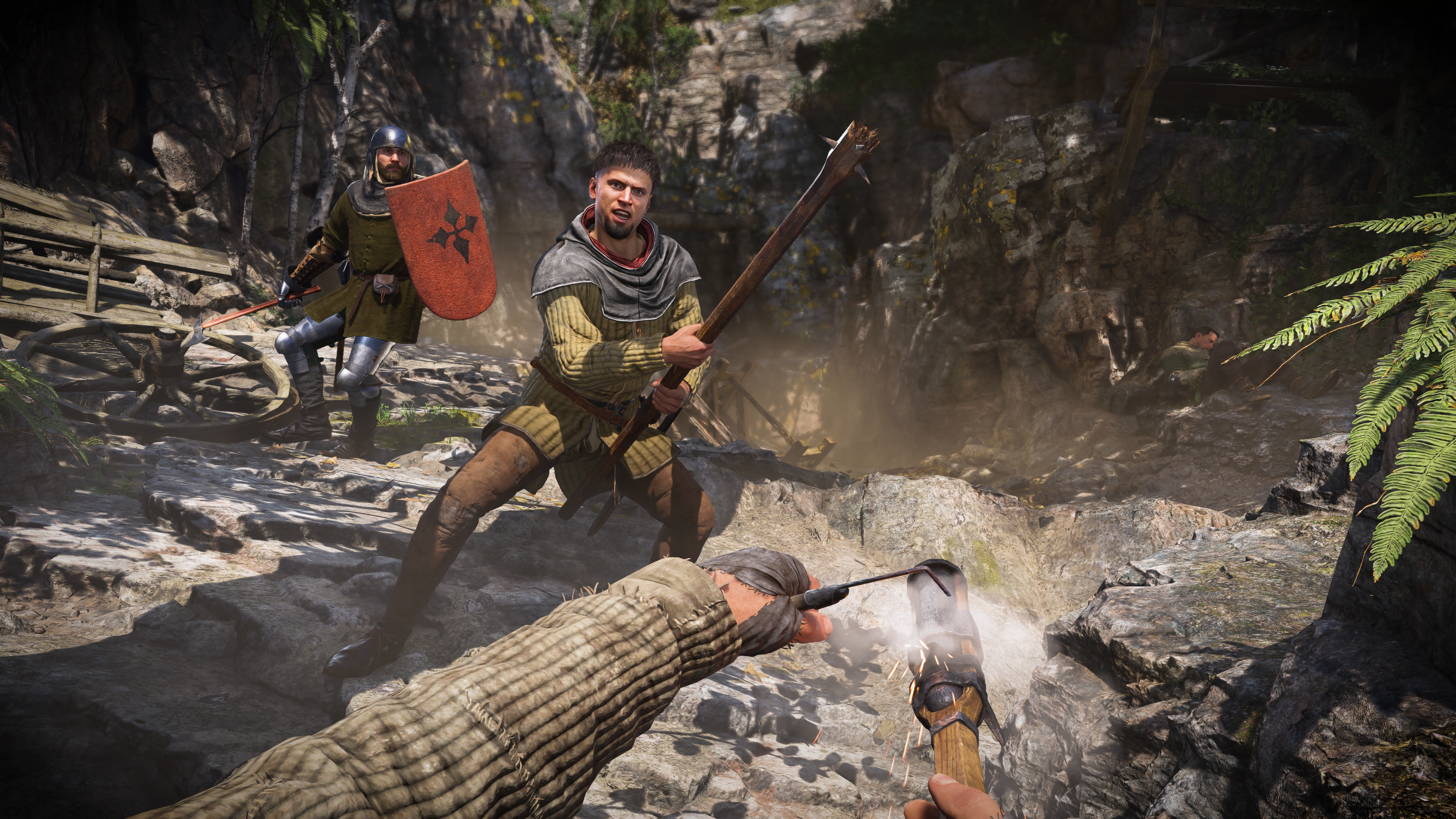
So one thing I wasn’t entirely expecting going into this game was the sheer depth and variety in the many, many aspects of the gameplay. Like seriously, there are so many things you can do or interact with that this review would go on for dozens of minutes if I tried doing them all. Which is why I’m going to focus on a select few that I thought were most important, the combat, the skill system, the survival aspects, and the dialogue, and then leave the rest for you all to experience yourselves.
Kingdom Come: Deliverance 2 is of course a first-person game most of the time. You’ll get a few cutscenes or interactions where the camera pans out, but for the most part, it’s up and personal. This means first-person melee combat! I’ll be honest, there are very, very few games that have what I’d consider “good” first-person melee combat. Even the so-called best of the genre, like Vermintide can still feel janky or off to me. There’s no fully avoiding the jank, even with this sequel, but Deliverance 2’s systems force you to put thought and focus into every fight you take and I thought it worked wondrously.
This system is no secret to anyone who’s played the first game, but for those who haven’t, I’ll quickly go over it. The gist of it is that whenever you get into a fight with someone, be it an unarmed brawl or a fight to the death with a fully armored knight, an indicator that has several segments appears in front of you. Switching to a different segment changes where you’re attacking, such as from above, from the left or right side, from the centre, etc. You use this system to try and attack from undefended areas and to make sure you’re defending from where you need to as well. Speaking of, when an enemy attacks you and you’re positioned currently, you’re given an option to defend/parry as long as you time your input correctly. Do so, and you’ll be given an opportunity to counterattack, which can then be defended and counterattacked by your enemy, which you can then defend and counterattack and so on. I had some fights that went back and forth like this for a while, but it’s also important to remember that attacking uses your stamina every time. Run out, and you won’t be able to attack or defend properly.
C-C-C-C-C-Combo Breaker!

The last thing I’ll touch on here is the combo system. Essentially as you progress and level up (more on that later), you unlock more and more “combos” for your weapons. These are specific patterns you need to input to do guaranteed damage, break armour, etc. For example, the most basic combo is simply attacking from your right, then your left, and then your right again. This combo system adds a very welcome strategy to fighting, especially as they get more and more complicated. In every fight you need to make the judgment call on when you should press the attack, when you should defend, and when you should go for the kill. And believe me when I say that the combat in this game is not your typical “kill swathes of enemies as a video game character”.
During a side quest, I had to bring a horse back from a band of bandits that had stolen it. Used to other games, I figured I’d walk in, slaughter everyone, and ride the horse back in triumph. Fast forward an hour and I’m struggling to take down every enemy without the others realizing. Henry of Skalitz, at least at the start of the game, is not some mythical figure that can take on scores of men single-handedly. This is a lesson the game teaches you quickly and it’s one that’s important to learn. Heck I would even fail stealth takedown attempts on the more armoured folks, forcing me to fight them face-on. I did eventually take the camp down, but it required me to wait until nighttime so that the tougher enemies had a torch equipped rather than a shield, and me making sure I never fought more than one bandit at a time. It was a slow, methodical approach and it took me more than an hour but finally succeeding felt fantastic and was another lesson to me on how this game worked.
You Are What You Do

There’s even more to combat of course, but it’s about time we talked about player progression. Kingdom Come: Deliverance 2 uses a leveling system that I very, very much appreciate. Namely that you get exp for the various skills you have, such as Survival, Alchemy, Unarmed Combat, etc. by utilizing the skills themselves. As in, if you fight people with your bare hands then you level up Unarmed Combat, if you interact with Mutt (your dog) then your Hound Master goes up etc. This sounds simple, I know, but in a time where most leveling in video games comes purely through combat, I very much appreciated this system. And then there’s also a “Main Level” that slowly goes up as you play through the game as well. As you level up, you obtain “Trait Points”, which you can use to unlock, well, traits, related to your various skills. For example, in the Survival skill you can unlock the ability to have your food spoil slower, or even the worst beds providing decent bonuses. I found every trait I unlocked to be something worthwhile, which is why the game’s system of only being able to choose one trait out of several when you level up works so well. It forces you to really think about what you want and how you’re going to play the game. Do you want to increase your damage with your initial strike, or with your combos? Do you want to put more defense to your helmet, or do you want to reduce the stamina cost of attacking? These are decisions you’ll have to make continuously throughout the game.
Also throughout the game, you’ll have to take into consideration various “survival game” mechanics, such as nourishment, your health, your tiredness, and more. While at first, these systems were a little annoying to me, I found that they weren’t hard to manage as you keep playing. You’ll often find some kind of bed to sleep on in most towns, or even in random houses in the wilderness so that takes care of your health or tiredness. And you can either purchase food from inns or cook any wild game you hunt (though be wary of being caught as a poacher). There’s more, of course, such as washing your face or your clothes of grime, dirt, and blood to make sure you’re at least somewhat presentable at all times but I’ve already talked enough about all that. Though I’d be remiss if I didn’t mention the way the game handles dialogue.
Be Careful What You Say

I knew I was playing a different kind of game almost instantly when a dialogue check I expected to pass easily ended up failing. This small but important moment taught me many things about Kingdom Come: Deliverance 2’s design philosophy. You see, I’ve played so many RPGs with dialogue trees that I often find myself defaulting to whatever dialogue choice I think my character has the best chance in succeeding at. In this specific case, it was an Intimidation check, which had the biggest number next to it, which made me think this one had the highest chance of success. And yet when I attempted it, the person I was talking to rightly reprimanded me for my hypocrisy as just before I had said I was more of as scribe than a soldier. Essentially, the game kept track of what I had said previously in the conversation and used that to point out inconsistencies. This was a novel experience for me as someone who’s only really considered the specific question being asked and my response to it, rather than the entire previous dialogue as whole.
This design philosophy is present throughout the entire game. Do you want to ask an innkeeper if you can rent a bed? You better make sure you’re well dressed and that your reputation in the area isn’t bad. You want to convince someone to let you borrow money? Well, you’d best have a good enough reason for this person specifically to do so. This brought a level of intimacy with the dialogue that few other games I’ve played had, where more than ever I had to put myself into the shoes of everyone I spoke to. And, of course, Henry’s as well.
Which is where I’ll briefly touch on the humour in the game, of which there is quite a bit. While Kingdom Come: Deliverance 2 has more than its share of very serious, dramatic moments, the whole game is also full of a playful, adventurous tone. Nothing brings this out quite so much as some of the dialogue of Henry’s. Henry, as a son of a blacksmith, isn’t exactly a genius of words and that’s something you need to consider as you try to use dialogue to get what you want. In one very humorous quest where you’re trying to act as a wingman, I laughed out loud several times when Henry tried desperately to convince this girl to give this other man a chance and failed spectacularly. Which of course led to an angry fistfight. Though all jokes aside, the interactions Henry has with the many, many people he meets throughout the journey is a core part of the game and it’s a great thing that Warhorse Studio’s dialogue design encourages putting effort and thought into your decisions.
Now That’s Wallpaper Worthy

I did also want to touch on the presentation of the game as well. Visually, the game can range from looking fantastic to simply good. I found no issues in the graphical prowess of the game playing on an Xbox Series X and instead often found myself stopping and appreciating the sights. The music, which ranged from whimsical to energetic and more, helped set the tone and setting of the game well.
Thankfully my experience in terms of game-breaking bugs, was for the most part, pretty good. Which was a little surprising, as I generally expect a good amount of performance issues with a game of this scope, especially at release. The game has a performance and quality mode on Xbox Series X and while the 60 frames weren’t always perfect, I found that it held strong for much of my time with the game, dropping only every so often. I did, however, have some issues with some of the pathing or game mechanics clashing with quests.
Not Quite Perfect

With a game full of so many mechanics, it came as no surprise to me when they’d clash a little. For example, in a quest where I have a friendly fistfight with someone, the people around me are reacting as they would if I started fighting some random person for no reason. Some yelling or jeering would be fine, but there was a time when I had guards come after me too. Heck at one point I was stuck in a save loop of being killed instantly after a dialogue ended. Thankfully the game keeps many of your previous saves (though it doesn’t quite save the game often enough for my liking), so I was able to revert to a save 20 or so minutes earlier.
Speaking of which, the game uses a system where you need to drink a consumable in order to save exactly when you want to. Otherwise, the game saves during quest progression, when you sleep, or when you exit to main menu. This last one was very useful as I didn’t always have the consumable on me, but it feels like a mostly useless restriction to a game that at times doesn’t save even after half an hour of playing.
Other than that, I also had some problems with the pathing or moving in rougher terrain. I often found myself stuck in geometry that I should have had no issues moving on or getting above. Most of the time this wasn’t really an issue, as I’d just go around or jump, but when it happened in the heat of combat, it got real irritating, real quick.
Slow and Steady

What I think is the biggest strength of Kingdom Come: Deliverance 2 is at times also one of its biggest weaknesses. You see, while there are many big and important things happening as you play, the very core and, dare I say it, the soul of the game is in the small, quieter moments. It’s not always about taking down a corrupt noble or storming a castle. More often than not, life is about the little moments between those you interact with or those you affect.
This is something this game does very well, where almost every character you meet has their own story happening independently of your own. Quite often while I was investigating one person’s request, I’d find myself drawn to the story and plight of another, even if it was “mundane”, compared to most quests we see in video games. I’d get a glimpse into the lives of people who have their own problems at hand and can’t bring themselves to care much for the overarching politics. Warhorse Studio’s did a stupendous job of bringing these concepts to life in a way I hadn’t really seen before, even if it also meant that sometimes the pace would slow down to a complete crawl, which wasn’t always a good thing. This is a game where you take your time as you play, rather than rushing through and trying to complete every little thing as soon as you can. Though one thing is for sure, you’re going to get more than your share of gameplay hours with this one.
Kingdom Come Deliverance 2 can be slow and lethargic, sometimes to a fault. It’s a game that’s more concerned with the plight of a villager than the saving of a kingdom. And yet it’s in those very moments, the conversations in the back of a cart, the early morning horse rides in the brisk, cold air; that the magic, charm, and humanity of it all shines brightest.
Kingdom Come: Deliverance II Review
Played on
Xbox Series X

PROS
- Combat is full of depth
- Every story matters
- Fantastic world building
- A dialogue system that takes into account everything you say
- Stupendous amount of content
CONS
- A little too slow at times
- Game mechanics can clash with eachother
- A little janky
- Game does not save often enough and the consumable save system isn't good