Two years, one summer that lasts for a lifetime. That is seemingly the first goal of the three friends of developer’s Lorenzo Redaelli and EYEGUYS and publisher Santa Ragione’s. ‘Mediterranea Inferno’. Off to a summer villa in Claudio’s late grandfather’s summer villa in the country, he along with his friends Mida and Andrea will spend a total of three days in summer bliss. Or so it would seem, as things take a dark turn in this story about love, compassion, hopelessness, and a struggle for identity (especially among LGBT) with the young.


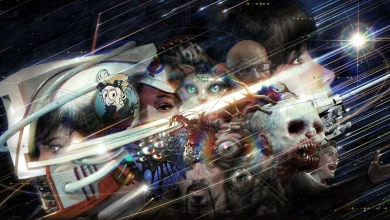
Mediterranea Inferno is primarily a visual novel. Outside of a few selections you can make to get different dialogue choices and experience the game’s multiple endings, you’re largely going to be sifting through text and Inferno’s extremely gorgeous art style and presentation. Our Andrea, Claudio, and Mida are drawn and animated with splendour and the use of 2D and 3D among a restrictive but flashy colour palette. Mediterranea Inferno is bloody photogenic, but it keeps its focal points simple and uses lighting in its favour as it portrays the catalysts of our trios’ plights. Italy has never looked so good and it plays as a strength to the game’s main scenario and writing.
It’s a hot summer day on Day One at the summer villa. Lines of coke sit at the table and Claudio, Mida, and Andrea are discussing what fun they’ll have, forgetting about the catch-up part. The last time they had seen each other was back in 2020 right before the COVID-19 pandemic. It’s the perfect set up for an amazing summer, but it doesn’t take long to realise that our trio have their troubles out for them. Spelling out what troubles them would be entering spoiler territory and I don’t want to go there, but each one of our protagonists is on a soul search for inner peace, a sense of belonging, a connection to their pasts. They’re all extreme and extravagant in their own way, but a lot of it is for show to hide the problems in-between. As a Gen Z-er with a possible disposition for the Millennial era, I connected to that sense of loss from a sudden lockdown that cut a lot of my goals and personal progression short.
Inferno’s writing is its greatest strength. It incorporates religion, Italy’s arts and culture, and sex symbolism against flashes of confusion and sin to portray our protagonists in their struggles. These battles aren’t just within but with each other, a repeating circle of pain that is influenced by a recovering society post-pandemic and the political climate of the country impacting the lives of its LGBT denizens and really, its youth and Italy’s future. The dialogue is believe as it is impactful thanks to the game’s beautiful and sometimes outright bizarre imagery. But even then the game will ultimately outright spell out the motivations of our characters, which I felt was unnecessary. Subtlety works wonders as it taps into the reader’s imagination and can elevate the narrative experience—and I wish this Mediterranea Inferno trusted me to understand its themes.

This game isn’t a long experience, instead the game encourages players to replay the main path and unlock all of the game’s available endings. Mirages are your key to opening different “worlds” so to speak and you will be able to purchase them with the game’s available currency as you collect ’em. Don’t spend it all in one place lest you leave one of the three behind. Whether you experience a mirage or not, the story moves on and you’ll get to see the consequences—often viscerally. I only wish it had an auto play feature, as mashing A to continue reading through dialogue over and over gets a little annoying.
Mediterranea Inferno is an excellent contemporary visual novel that will connect to you even through its eccentricities. A gorgeous presentation along with a mash of personal struggle grounded in Italian culture and LGBT-positive themes. ∎
Mediterranea Inferno
Played on
Xbox Series X

PROS
- Extremely stylish visuals and audio effects, beautiful presentation.
- Strong writing and narrative structure.
CONS
- No autoplay function.
- Script occasionally gets too on the nose with its themes.